
Florida Mold License Exam Prep Tips: How to Pass the MRSA and MRSR on Your First Try
Jun 11, 2026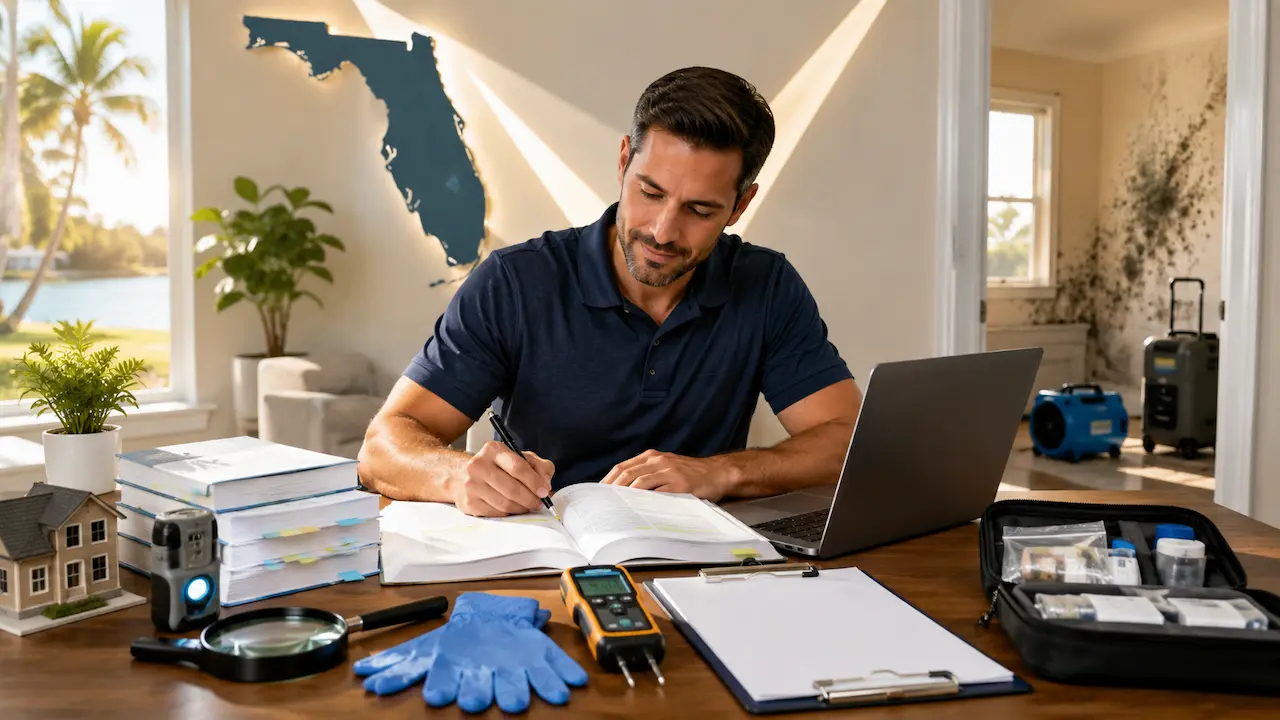
If you are getting ready to take the Florida mold license exam, you already know the stakes. Passing the MRSA or MRSR exam is the final step between you and a licensed career in one of the most in-demand trades in the state. Florida's humidity, storm history, and aging housing stock mean mold professionals stay busy year-round. But the exam itself is no joke and walking in unprepared is the number one reason people fail on their first attempt.
This guide breaks down exactly how to study, what to focus on, and how to walk into that exam room with confidence.
What Is the Florida Mold License Exam and Who Needs It
Before diving into prep strategies, it helps to understand what you are actually being tested on. Florida requires anyone performing mold-related services professionally to hold either a Mold-Related Services Assessor (MRSA) license or a Mold-Related Services Remediator (MRSR) license, regulated by the Florida Department of Business and Professional Regulation (DBPR).
The MRSA exam tests your knowledge of mold assessment techniques, inspection protocols, sampling methodology, and documentation. The MRSR exam focuses on remediation processes, containment procedures, chemical safety, respiratory protection, and post-remediation verification.
You can sit for one or both exams. Many professionals choose to earn both licenses to maximize their service offerings and earning potential.
Start With the Right Study Materials
The biggest mistake exam candidates make is trying to study without a structured framework. The Florida mold exam is based on a specific set of industry standards and reference documents. Knowing which materials to focus on saves you dozens of hours of wasted study time.
The core references the exam draws from include the IICRC S500 (Standard for Professional Water Damage Restoration), the IICRC S520 (Standard for Professional Mold Remediation), the IICRC R520, EPA mold remediation guidelines, and the New York City Guidelines for Mold Assessments and Remediation.
You do not need to memorize these documents word for word. But you do need to understand the frameworks, the recommended protocols, and the definitions they establish. Familiarize yourself with terminology like "condition 1, 2, and 3" mold classifications, clearance testing standards, and work area containment levels.
Get a Course Booklet and Actually Use It
If you are enrolling in a state-approved training course which is required for most applicants your course booklet is your most important study tool. Do not set it aside after class. Review it again on the evening of day two, before your exam on day three. Highlight key terms, revisit the sections on sampling methodology and respiratory protection, and write out short notes in your own words. Active recall beats passive re-reading every time.
Understand the Exam Format Before Test Day
The Florida mold license exam is a proctored, multiple-choice exam. Knowing what to expect reduces test anxiety significantly. Questions are designed to test applied knowledge, not just memorization. You will see scenario-based questions that describe a real-world situation and ask what you would do which containment protocol applies, which sampling method is appropriate, or what the correct PPE selection is for a given scenario.
Focus Areas for the MRSA Exam
For the Mold Assessor exam, prioritize these content areas during your prep:
Building science fundamentals and moisture intrusion pathways are heavily tested. Know how water moves through building assemblies, where condensation forms, and why vapor barriers matter. Sampling methodology is another major area understand the difference between air sampling, surface sampling, bulk sampling, and when each is appropriate. Documentation and report writing standards also appear frequently, so understand what a proper mold assessment report must include.
Focus Areas for the MRSR Exam
For the Mold Remediator exam, the emphasis shifts to the practical side. Containment setup and negative air pressure are major topics know the difference between limited, full, and critical containment zones. PPE selection and respiratory protection requirements are tested extensively, including the difference between N95 respirators, half-face respirators, and supplied air equipment. Chemical usage, antimicrobial application standards, and waste disposal protocols round out the core content areas.
Study Techniques That Actually Work for Trade Exams
Not everyone learns the same way, but certain study techniques are consistently more effective for licensing exams in technical trades.
Spaced repetition works better than cramming. If you have a few weeks before your exam, study for 30 to 45 minutes each day rather than six hours the night before. Your brain consolidates technical information during sleep, so consistent shorter sessions outperform marathon study blocks.
Create a simple question deck from your course materials. Write a term or scenario on one side, the answer on the other. Go through them until you can answer without hesitation. Focus extra time on anything you miss twice.
Form a study pair or small group with another student from your course if possible. Explaining a concept out loud like why you would choose air sampling over surface sampling in a specific scenario forces you to genuinely understand it rather than just recognize it on a page.
Take Advantage of Hands-On Training
One of the most underrated exam prep strategies is taking the hands-on components of your training seriously. The Florida mold license course is not just about sitting through lectures. Demonstrations, mock inspections, and real-world scenario walkthroughs help you build the mental models that translate directly to exam answers.
When your instructor walks through a containment setup or demonstrates proper sampling technique, pay close attention. Ask questions. These moments of applied learning anchor abstract concepts in your memory far more effectively than re-reading a chapter.
At NIAQI National Indoor Air Quality Institute, the three-day training is specifically structured around this principle. Days one and two cover lectures, building science strategies, and hands-on demonstrations. Day three is exam day, preceded by a final review with your instructor. This format is designed so that what you practice in the room directly mirrors what you face on the exam.
Common Mistakes That Cause People to Fail
Understanding where other candidates go wrong gives you a real advantage.
Underestimating the moisture and building science section is a common trap. Many people assume the exam will focus mostly on mold biology and remediation chemicals. In reality, a significant portion of questions are rooted in building science how moisture enters a structure, what drives mold growth conditions, and how to trace an IAQ problem back to its source.
Skipping the EPA guidelines is another mistake. The EPA's mold remediation guidance documents are referenced in exam questions and contain specific recommendations around clearance criteria, communication with building occupants, and decision-making for different contamination levels.
Arriving without reviewing your notes the morning of the exam is also a mistake. A quick 20-minute review of key terms and protocols before you sit down refreshes your short-term memory and settles pre-exam nerves.
What Happens After You Pass
Passing the exam is a major milestone, but it is not the final step. After passing, you apply for your MRSA or MRSR license through the Florida DBPR. You will need to submit your application form, pay the licensing fees (currently a $125 application fee plus $100 licensure fee plus a $5 unlicensed activity fee), submit electronic fingerprints through an approved Livescan vendor, and demonstrate your documented field experience or educational qualifications.
Once licensed, you are required to complete 14 hours of continuing education every two years to maintain your license. This is where CEU courses become important and staying current with IAQ industry developments keeps your skills sharp and your license active.
How to Choose the Right Mold License Training Course
Not all Florida mold license courses are equal. The quality of instruction, the depth of course materials, and the exam preparation support vary significantly between providers. When evaluating a course, look for state DBPR approval, instructors with real field experience rather than purely academic backgrounds, and a format that includes hands-on demonstration alongside classroom instruction.
NIAQI's Florida mold license training and certification course covers all required content for both the MRSA and MRSR exams, includes course booklets, instructor-led demonstrations, and the exam itself on day three. With instructors who bring over 50 combined years of field and classroom experience, the course is built around one goal: making sure you pass and are ready to work.
If you are also interested in what specific licenses you need and whether you qualify, the Florida mold license requirements page on the NIAQI site covers the full DBPR regulatory requirements including education, experience, fingerprinting, and application steps.
Final Thoughts
The Florida mold license exam is challenging but very passable with the right preparation. Know your reference materials, engage fully in your training course, use active study methods, and go into exam day with a clear understanding of what is being tested. The license you earn opens doors to a recession-proof career in a state that will always need qualified mold professionals.
If you are ready to take the next step, explore the mold assessor license and mold remediation license service pages to understand exactly which path is right for you and register for the next available session before seats fill up.
Get mold industry news and updates from NIAQI.
Join our mailing list to receive the latest news and updates from our expert mold instructors.
Don't worry, your information will not be shared.
We hate SPAM. We will never sell your information, for any reason.

