
What's the Demand for Certified Mold Inspectors?
May 12, 2026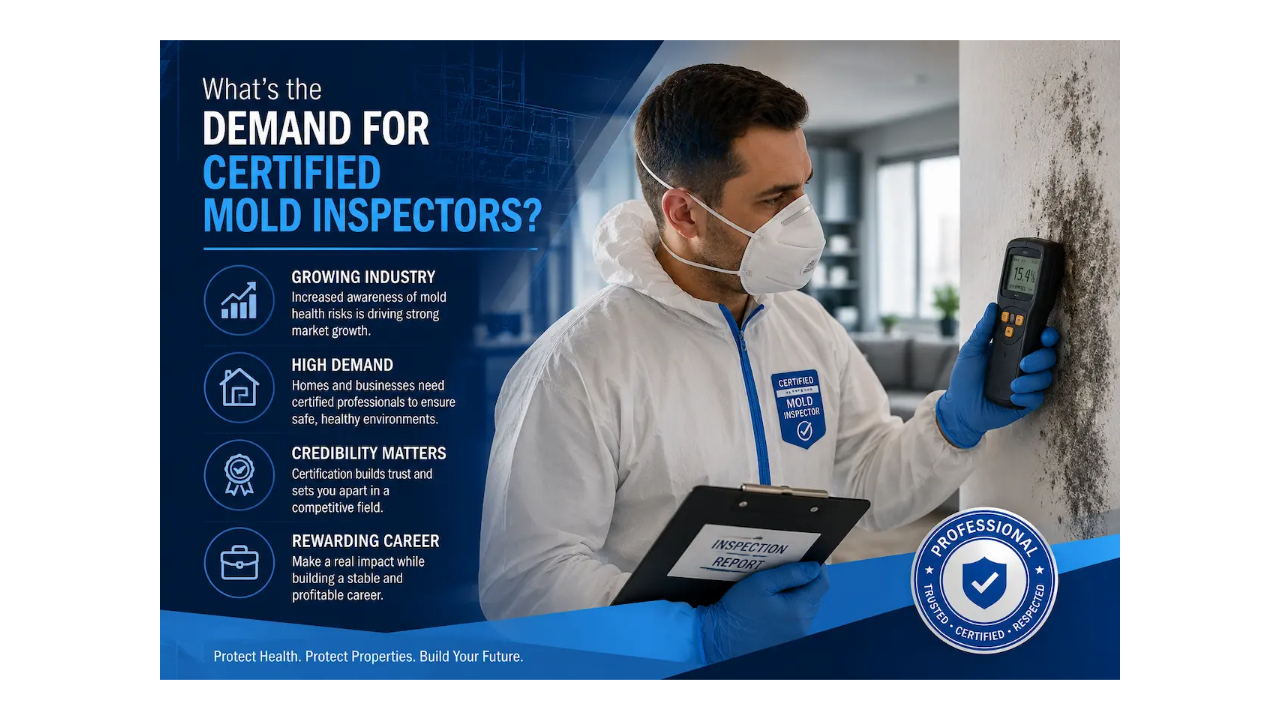
What Is a Certified Mold Inspector?
A certified mold inspector also called a mold assessor in Florida is a licensed professional trained to identify, evaluate, document, and report mold contamination in residential, commercial, and industrial properties. Their work includes investigating moisture sources, performing air and surface sampling, interpreting laboratory results, and producing official mold assessment reports used by homeowners, real estate agents, insurance companies, and remediation contractors.
In Florida, mold inspectors must hold a Mold Assessor License (MRSA) issued by the Florida Department of Business and Professional Regulation (DBPR), governed under F.S. 468 and F.A.C. Rule 61-31. Licensing requires completing a state-approved training program, passing the official mold assessor exam, and meeting continuing education obligations.
Learn more about the Mold Assessor License in Florida.
Introduction: Why Mold Inspection Has Become a High-Demand Career
Mold is no longer a hidden issue that property owners shrug off. In 2026, it sits at the intersection of public health, real estate, insurance, and climate response making certified mold inspectors one of the most consistently in-demand professionals in the indoor air quality (IAQ) industry.
Florida is at the center of this national demand. The state's subtropical climate, year-round humidity often between 74% and 90% in South Florida, heavy annual rainfall (Miami alone receives 60+ inches per year), and active hurricane season create one of the most mold-prone environments in the United States. Industry data confirms that mold can begin colonizing wet building materials in as little as 24 to 48 hours when indoor humidity exceeds 60% a daily reality across most of Florida.
The result? Homeowners, property managers, insurance adjusters, real estate professionals, and contractors all rely on certified mold inspectors more than ever before. Mold inspection has evolved from a niche specialty into a stable, year-round, recession-resistant profession with strong income potential.
Read our guide on how to become a mold inspector in Florida.
Current Demand for Certified Mold Inspectors in 2026
Several powerful market forces are fueling the surge in demand for licensed mold inspectors:
- Climate and Weather Events After major hurricanes like Ian (2022) and Idalia (2023), inspection demand in affected Florida counties surged so dramatically that wait times stretched to 2–3 weeks, with emergency rates running 30–50% above standard pricing. Every storm season generates a new wave of inspection work.
- Aging Florida Building Stock A large share of Florida's housing was built decades ago and now suffers from roof deterioration, HVAC inefficiencies, and hidden moisture intrusion all conditions that require professional mold assessment.
- Real Estate Transactions Buyers and sellers now routinely include mold inspections in their due diligence. A clear mold report can make or break property deals worth hundreds of thousands of dollars.
- Insurance Industry Requirements Insurance companies regularly require licensed mold assessments before approving water damage or storm-related claims creating a steady, high-volume client pipeline for certified inspectors.
- Growing Health Awareness More homeowners are linking allergies, asthma flare-ups, sinus issues, fatigue, and respiratory symptoms to indoor mold exposure, driving demand for objective certified testing.
- New Regulatory Pressure With Florida's 100% continuing education compliance requirement now mandatory by July 31, 2026, and tighter enforcement of licensing rules, the market is increasingly rewarding properly trained, certified professionals over unlicensed operators.
Related: Do You Need a License to Remove Mold in Florida?
Mold Inspector Salary and Job Outlook (2026 Data)
Current U.S. compensation data shows strong income potential for certified mold inspectors:
- National average salary: approximately $66,651 per year (~$32/hour) per Glassdoor 2025 data
- Entry-level inspectors (1–3 years): $30,000–$40,000 per year
- Senior inspectors (8+ years): $47,000–$75,000+ annually
- Projected salary growth: ~12% over the next five years
- Per-inspection pricing in Florida: $200–$600 (standard), with post-storm rates often 30–50% higher
- Independent operators: frequently exceed national averages by running their own assessment businesses
Florida inspectors typically earn above the national average due to consistent year-round demand and the higher rate of insurance and post-disaster work.
See our detailed breakdown of mold inspector income in Florida.
Benefits of Becoming a Certified Mold Inspector
A career as a certified mold inspector offers a rare combination of stability, income, freedom, and meaningful work. Here's why thousands of professionals are entering the field in 2026:
- Strong, Recession-Resistant Demand Mold doesn't pause during economic slowdowns. In fact, demand often rises when homeowners delay maintenance or when storms cause damage.
- High Income Potential per Job With inspections priced between $200 and $600+, a full-time inspector completing 4–5 jobs per week can generate strong six-figure-potential revenue over time.
- Fast, Affordable Path to a Professional License Unlike careers requiring years of college and high tuition costs, you can become a certified Florida mold inspector through a focused training program and exam.
- Flexible Career Options Work for an established mold assessment firm, partner with restoration companies, serve property management groups, or build your own independent business.
- Be Your Own Boss Mold inspection is one of the most common gateways to owning a service business with low overhead and high margins.
- Meaningful, Health-Focused Work You directly help protect families from harmful indoor contaminants, prevent structural damage, and guide proper remediation decisions.
- Long-Term Career Growth Certified inspectors often expand into mold remediation, HVAC assessment, water damage certification, indoor air quality consulting, or expert witness services.
Related read: Is Mold Remediation a Profitable Business?
Who Hires Certified Mold Inspectors?
Certified inspectors serve a wide range of clients across multiple industries, including:
- Homeowners and renters
- Real estate agents and brokers
- Home inspection companies
- Property management firms
- Insurance adjusters and claim companies
- Restoration and remediation contractors
- Schools, hospitals, and government buildings
- Hotels, resorts, and commercial property owners
- Attorneys handling mold-related litigation
This diverse client base is why mold inspection careers remain stable even during slower real estate cycles.
Why Choose NIAQI (Florida Mold Course) for Your Certification?
If you're ready to step into this growing industry, the quality of your training will directly shape your long-term success. NIAQI (National Indoor Air Quality Institute) is one of Florida's most trusted names in mold inspector and remediation training and was Voted Best Mold Certification Course in 2023.
Here's why students choose NIAQI to earn their Florida mold license:
- State-Approved Curriculum Our programs lead to the Certified Air Quality Consultant (CAQC) and Certified Air Quality Remediator (CAQR) credentials fully recognized by the Florida DBPR.
- Instructors with 50+ Years of Combined Experience You learn from industry founders and senior professionals with 20+ years in the classroom not generic instructors reading from a script.
- Comprehensive 3-Day In-Person Course Days 1 and 2 cover IAQ science, moisture management, building forensics, sampling methodology, health and safety, HVAC, and remediation strategy. Day 3 includes hands-on training and your state certification exam — leave certified and ready to work.
- Practical, Career-Focused Training You don't just prepare for an exam. You learn how to perform inspections, write professional reports, communicate with clients, and price your services correctly.
- Ongoing Support Through the NIAQI Portal After certification, you get access to downloadable resources, advanced course materials, and exclusive industry updates.
- Continuing Education (CEU) Options With Florida's 100% CE compliance requirement now in effect, NIAQI offers approved CEU courses to keep your license active and your expertise sharp.
Register for the next NIAQI Course & Certification →
How to Get Started as a Certified Mold Inspector in Florida
Becoming a certified mold inspector in Florida is more straightforward than most professional careers:
- Confirm basic eligibility (18+ years old, high school diploma or equivalent)
- Enroll in a state-approved training program such as NIAQI's 3-day course
- Complete the required training hours and hands-on components
- Pass the state mold assessor exam
- Apply for your Mold Assessor License through the Florida DBPR
- Stay current with continuing education to maintain your license
See the full Florida mold license requirements.
Frequently Asked Questions (FAQs)
Q1: Is being a mold inspector a good career in 2026?
Yes. With rising humidity-related issues, climate events, real estate demand, and growing health awareness, certified mold inspectors are in strong demand — particularly in Florida, where work is steady year-round.
Q2: How much do certified mold inspectors make in Florida?
Most Florida mold inspectors earn between $50,000 and $80,000 annually, with experienced inspectors and business owners often earning significantly more.
Q3: Do you need a license to inspect mold in Florida? Yes. To perform mold assessments for compensation in Florida, you must hold a state-issued Mold Assessor License from the Florida DBPR.
Q4: How long does it take to become a certified mold inspector?
With an accelerated program like NIAQI's 3-day course, you can complete training and the certification exam in under a week, then submit your state license application.
Q5: Is mold inspection different from mold remediation?
Yes. Inspectors identify and document mold problems, while remediators perform the actual cleanup. Many professionals earn both licenses to expand their service offerings and income.
Q6: How much does mold inspector certification cost in Florida?
Costs vary depending on the training provider and exam fees. See our full breakdown on mold certification cost in Florida.
Final Thoughts
The demand for certified mold inspectors in 2026 is stronger than it has ever been — and Florida continues to be one of the most opportunity-rich states in the country for this profession. With high humidity, frequent storms, aging buildings, stricter regulations, and growing health awareness, mold inspection is a career path with long-term stability, strong income, and meaningful impact.
If you're ready to enter this growing industry the right way, NIAQI is here to help you earn your Florida Mold Assessor License with confidence, expert instruction, and hands-on training.
Register for the Next NIAQI Course & Certification →
Get mold industry news and updates from NIAQI.
Join our mailing list to receive the latest news and updates from our expert mold instructors.
Don't worry, your information will not be shared.
We hate SPAM. We will never sell your information, for any reason.

