
How to Read a Mold Air Test Report: Spore Trap Counts and Indoor vs Outdoor Comparison
Nov 02, 2026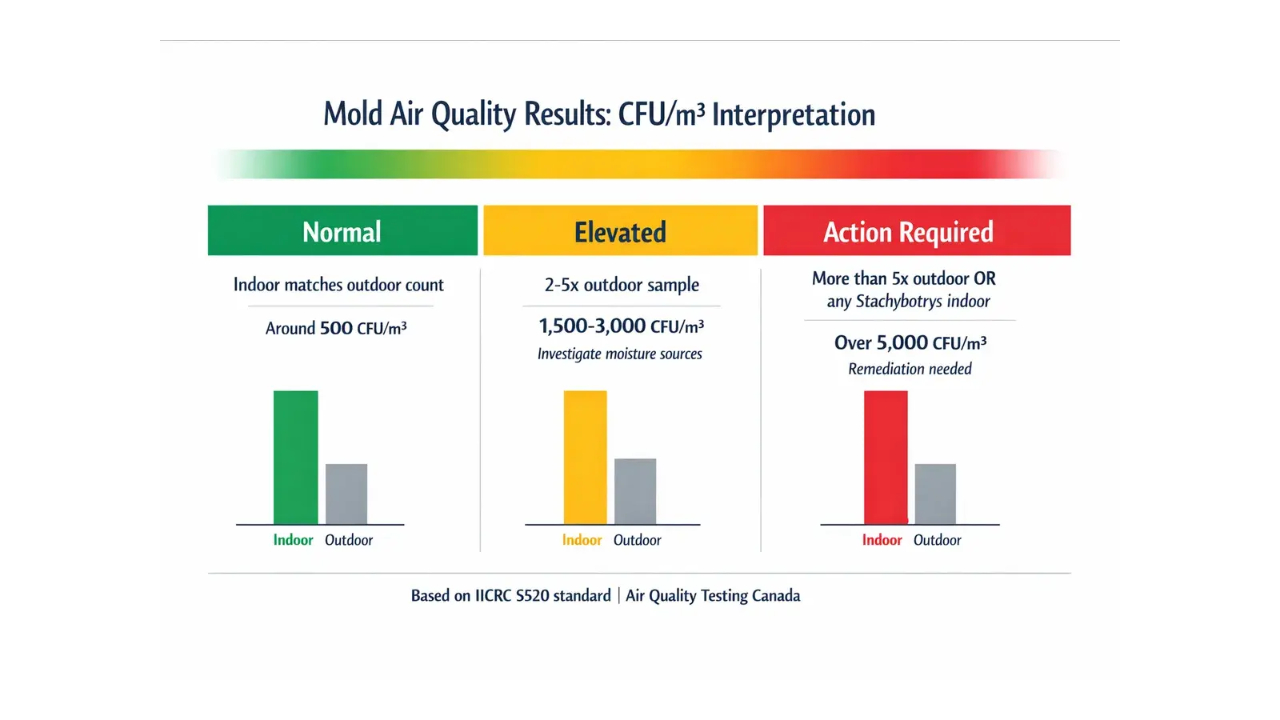
Quick Answer: A mold air test report lists the mold types found in each sample, the raw count the analyst saw under the microscope, and a calculated concentration in spores per cubic meter (spores/m³). To read it, compare every indoor sample with the outdoor sample taken the same day. If indoor levels are similar to or lower than outdoor, with the same mix of mold types, that usually points to normal infiltration. Higher indoor counts, a different dominant mold type, or water-damage indicators point toward an indoor source.
Why There Is No “Pass” Number for Mold
Most people open a lab report looking for one safe limit. That number does not exist. The U.S. EPA states that no standards or threshold limit values have been set for airborne concentrations of mold or mold spores. EPA also recommends that sampling be done by professionals with specific experience in designing sampling protocols and interpreting results. epaepa
So a spore trap result only means something in context. That context is the outdoor control sample, the building’s water history, and what the assessor found during the visual inspection.
The Key Columns on a Spore Trap Report
Lab layouts vary, but most reports share the same core fields:
- Sample volume: Many residential samples are collected at 15 liters per minute for five minutes, which gives a 75-liter sample. Check this first, because a short or failed run changes every number below it.
- Raw count: This is the number of spores actually present on the sample the lab received. legvi
- Spores/m³ (count/m³): This is an extrapolated concentration, calculated from the raw count and the volume of air sampled. legvi
- Detection limit (analytical sensitivity): This is the concentration a single spore represents. On a 75-liter sample, one spore can equal about 13 spores/m³. A result of 13 or 27 may therefore reflect only one or two spores. stamfordct
- Debris rating: Labs score debris from 0 to 5. Heavy debris can hide small spores such as Aspergillus/Penicillium, so counts at ratings 4 or 5 should be read as minimums. At the highest rating, the lab may recommend resampling. eurofins
How to Compare Indoor and Outdoor Samples
The indoor vs outdoor comparison is the heart of interpretation. Work through it in this order:
- Confirm a same-day outdoor control exists. Outdoor spore levels shift with weather, rain and season. Without a control taken at the same time, indoor numbers have no baseline.
- Compare total spore counts. Indoor totals well above outdoor deserve a closer look.
- Compare mold types one by one. This is called rank order. Suppose the outdoor sample is dominated by Cladosporium and basidiospores, but the indoor sample is dominated by Aspergillus/Penicillium-like spores. That mismatch suggests indoor growth even when the totals look similar.
- Compare rooms against each other. A single room with higher counts helps narrow down where the moisture problem is.
There is no universal ratio that defines a problem. Some labs, for example, flag an indoor-to-outdoor ratio above 2 for any genus on the same sampling day as suggesting an indoor source. Treat any lab’s color coding as a screening tool, not a final verdict. sysco-env
Water-Damage Indicator Molds to Watch For
Some genera carry more weight than others. Stachybotrys is associated with paper, wallpaper and gypsum board. Chaetomium is associated with cellulose-containing materials. Labs commonly flag both as water-damage indicators. eurofins
Even low levels of these spores indoors can indicate moisture issues. Their spores are heavy and sticky, so they do not stay airborne easily. A count of just one or two spores can still matter. ccc
You will also see “Aspergillus/Penicillium-like” reported as one group. The two cannot be told apart by direct microscopy because their spores are small and have few distinguishing features. eurofins
A Simple Example
The figures below are illustrative only, not from a real job.
|
Sample |
Total spores/m³ |
Dominant type |
Notes |
|
Outdoor |
4,200 |
Cladosporium |
Same-day baseline |
|
Living room |
1,100 |
Cladosporium |
Same mix as outdoor, lower total |
|
Guest bath |
3,900 |
Aspergillus/Penicillium-like |
Different dominant type, Chaetomium detected |
The living room reflects normal infiltration. The guest bath has a total below outdoor, yet it is the concern: the mold mix has flipped and a water-damage indicator appears. Totals alone would have missed it.
What a Spore Trap Report Cannot Tell You
- Health risk: Spore counts cannot predict how a particular person will react.
- Living vs dead spores: Spore trap analysis is a non-viable method, so it counts both.
- Species-level identification: Many spores are identified only to genus or group.
- Hidden growth: Mold sealed inside a wall cavity may not show up in room air.
- Long-term conditions: Each sample is a five-minute snapshot of conditions at that moment.
This is why air sampling supports a visual inspection and moisture mapping but never replaces them. If you are seeing stains or smelling a musty odor, start with our guide on how to detect mold in your home. If counts are high near supply vents, read about mold in your air conditioner.
Who Should Interpret Your Results
In Florida, mold assessment for compensation requires a state license. Before hiring anyone, run a quick Florida mold license lookup to confirm active MRSA status. To understand what a full assessment with lab sampling involves, see how licensed assessors set mold inspection prices.
Build the Skill Professionally
Sampling methodology and interpretation is a core module in NIAQI’s Florida mold assessor license course, taught by licensed instructors who read these reports in the field. NIAQI students also receive lab sample credits and equipment discounts from our sponsors. Licensed professionals can sharpen their report-writing skills in our 14-hour mold CEU course.
Frequently Asked Questions
Is there a safe level of mold spores in a home?
No federal limit exists. Results are judged by comparing indoor samples with a same-day outdoor control and by checking which mold types are present.
Why is my indoor count higher than outdoor after rain?
Rain changes outdoor spore levels quickly, which is one reason the outdoor control must be collected at the same time as the indoor samples.
Can I read a DIY mold kit the same way?
No. Most home kits grow cultures in a dish and do not measure a known air volume, so their results cannot be compared with a spore trap report.
Get mold industry news and updates from NIAQI.
Join our mailing list to receive the latest news and updates from our expert mold instructors.
Don't worry, your information will not be shared.
We hate SPAM. We will never sell your information, for any reason.

